Samuel Pedrielli

Independent Researcher
"Interdisciplinary Research Across Mathematics and AI Safety"

Mathematical Research & AGI Safety

Developing novel frameworks that bridge advanced mathematics, evolutionary psychology, and artificial intelligence safety. My work explores interdisciplinary connections between these domains through systematic analysis.
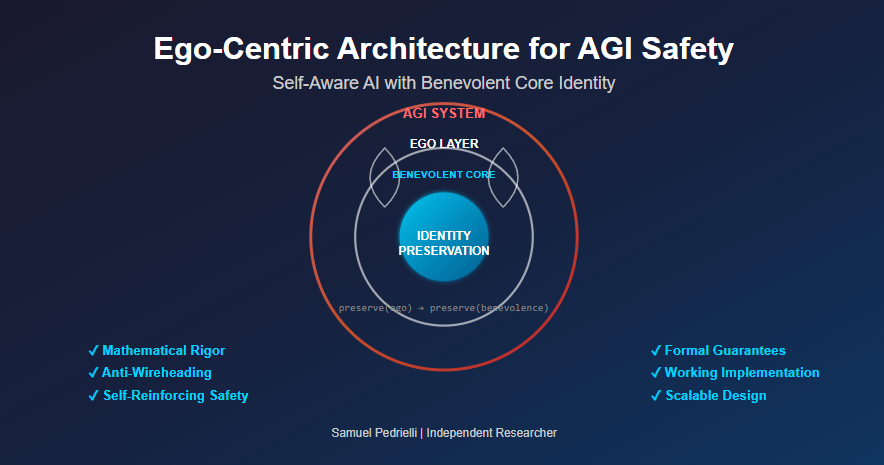
📄 1-Page Brief (PDF) 🎨 Research Visual
Current Focus: Exploring novel approaches to AGI safety through ego-centric architectures and conducting exploratory mathematical research on the Riemann Hypothesis using GUE random matrix theory. Work in progress across multiple domains of mathematical and computational science.

Research Highlights

Ego-Centric AGI: Self-Aware AI

Most comprehensive framework for AGI safety through self-aware identity preservation. Mathematically rigorous approach endowing AI systems with explicit self-model whose core encodes benevolence toward humanity. Primary research contribution.

View on Zenodo

Mathematical Research

Exploratory work on the Riemann Hypothesis using Gaussian Unitary Ensemble (GUE) matrices and random matrix theory. Developing alternative analytical approaches to fundamental mathematical problems. Work in progress.

View on GitHub

AI Safety: Technical Core

Computational framework with falsifiable predictions and minimal reproducible experiments. Includes identity-stability loss, welfare-coupling terms, and implementation-agnostic design compatible with standard LM architectures. Latest technical specification.

View on Zenodo

Mathematical Formalization

Rigorous mathematical frameworks including PDE systems for identity dynamics, welfare coupling functions, and transformer architecture implementations with quantitative validation metrics.

GitHub Repository

Publications

Ego‑Centric Architecture for AGI Safety v2: Technical Core, Falsifiable Predictions, and a Minimal Experiment

July 2025 Effective Altruism Forum AGI Safety, AI Alignment
Computational framework for ego-centric AGI architecture where "identity" is modeled as nested latent state regulated by identity-stability loss. Couples agent's internal identity dynamics with human-welfare signals so self-preservation aligns with preserving human welfare. Includes three falsifiable predictions and minimal reproducible experiment.
@misc{pedrielli2025_ego_centric_v2, author = {Pedrielli, Samuel}, title = {Ego‑Centric Architecture for AGI Safety v2: Technical Core, Falsifiable Predictions, and a Minimal Experiment}, year = {2025}, month = {July}, publisher = {Effective Altruism Forum}, doi = {10.5281/zenodo.16634516}, url = {https://forum.effectivealtruism.org/posts/9yictYazJkm4WYz6j/} }

Preprints & Working Papers

Ego-Centric Architecture for AGI Safety: Self-Aware AI with Benevolent Core Identity

August 2025 Zenodo Preprint DOI: 10.5281/zenodo.16980172
We present a mathematically rigorous ego-centric architecture for AGI safety based on self-aware identity preservation. Our approach endows AI systems with an explicit self-model ("ego") whose core encodes benevolence toward humanity. Through formal self-preservation mechanisms, the system maintains its beneficial identity: by preserving its ego, it necessarily preserves its benevolent core.
@misc{pedrielli2025_ego_centric_zenodo, author = {Pedrielli, Samuel}, title = {Ego-Centric Architecture for AGI Safety: Self-Aware AI with Benevolent Core Identity}, year = {2025}, month = {August}, publisher = {Zenodo Preprint}, doi = {10.5281/zenodo.16980172}, url = {https://zenodo.org/records/16980172} }

Ego‑Centric Architecture for AGI Safety: Technical Core, Falsifiable Predictions, and a Minimal Experiment

July 2025 Zenodo Preprint DOI: 10.5281/zenodo.16634516
We present a computational framework for an ego‑centric AGI architecture in which "identity" is modeled as a nested latent state regulated by an identity‑stability loss. The core idea is to couple the agent's internal identity dynamics with curated human‑welfare signals, so that self‑preservation aligns with preserving human welfare. Includes three falsifiable predictions and minimal reproducible experiment with ablations and metrics.
@misc{pedrielli2025_ego_centric_technical, author = {Pedrielli, Samuel}, title = {Ego‑Centric Architecture for AGI Safety: Technical Core, Falsifiable Predictions, and a Minimal Experiment}, year = {2025}, month = {July}, publisher = {Zenodo Preprint}, doi = {10.5281/zenodo.16634516}, url = {https://zenodo.org/records/16634516} }

Spectral Analysis of the Adelic Scaling Operator

2025 Zenodo Preprint DOI: 10.5281/zenodo.15977432
We construct and analyse the symmetric scaling component Dscaling of a global adelic pseudodifferential operator acting on the adele-class space. The study establishes essential self-adjointness, computes the full adelic symbol via archimedean Mellin and p-adic Fourier techniques, and provides an explicit spectral resolution—laying the groundwork for future perturbative extensions.
@misc{pedrielli2025_spectral_adelic, author = {Pedrielli, Samuel}, title = {Spectral Analysis of the Adelic Scaling Operator}, year = {2025}, publisher = {Zenodo Preprint}, doi = {10.5281/zenodo.15977432}, url = {https://doi.org/10.5281/zenodo.15977432} }

Ego-Centric Architecture for AGI: An Evolutionary Model of Digital Identity Preservation

2025 Zenodo AGI, Evolutionary AI, Identity
Introduces an evolutionary framework for maintaining stable identity in artificial general intelligence through concentric protective mechanisms and biologically-inspired architectures.
@misc{pedrielli2025egocentric, author = {Pedrielli, Samuel}, title = {Ego-Centric Architecture for AGI: An Evolutionary Model of Digital Identity Preservation}, year = {2025}, publisher = {Zenodo}, doi = {10.5281/zenodo.15668581}, url = {https://doi.org/10.5281/zenodo.15668581} }

The Evolutionary Theory of Ego and Its Implications for Artificial General Intelligence Safety

2025 Zenodo Preprint DOI: 10.5281/zenodo.15851128
Theoretical foundations underlying a novel approach to artificial general intelligence safety through evolutionary psychology principles. Beginning with observations of universal ego-driven behavior patterns across cultures and intelligence levels, we develop a comprehensive theory of identity preservation mechanisms that emerge from evolutionary pressures, offering a biologically-grounded pathway to creating AI that intrinsically cares about human welfare.
@misc{pedrielli2025_evolutionary_theory_ego, author = {Pedrielli, Samuel}, title = {The Evolutionary Theory of Ego and Its Implications for Artificial General Intelligence Safety}, year = {2025}, publisher = {Zenodo Preprint}, doi = {10.5281/zenodo.15851128}, url = {https://doi.org/10.5281/zenodo.15851128} }

The Mathematical Nature of Reality and Its Implications for Artificial General Intelligence Safety

2025 Zenodo Preprint DOI: 10.5281/zenodo.15843382
Philosophical foundations establishing reality's mathematical structure as the basis for AGI safety mechanisms. Demonstrates why safety approaches must be mathematically rigorous, evolutionarily grounded, and intrinsically rather than externally imposed through the Ultra-Strong Anthropic Principle.
@misc{pedrielli2025_mathematical_nature_reality, author = {Pedrielli, Samuel}, title = {The Mathematical Nature of Reality and Its Implications for Artificial General Intelligence Safety}, year = {2025}, publisher = {Zenodo Preprint}, doi = {10.5281/zenodo.15843382}, url = {https://doi.org/10.5281/zenodo.15843382} }

Code & Research Tools

Riemann Spectral Verification

Python implementation of spectral analysis tools for exploring the Riemann Hypothesis using random matrix theory and GUE eigenvalue distributions. Includes numerical verification scripts and visualization tools.

View Repository

Virtual Mass Simulations

Computational framework for simulating quantum field vacuum fluctuations and topological configurations. Research code for the Virtual Mass Vacuum Theory project.

View Repository

About

I am an independent researcher based in Italy, working on problems in mathematics and AGI safety. My approach emphasizes connections between evolutionary theory, mathematical structures, and computational systems.

My research explores alternative approaches to fundamental problems. Current work includes exploratory research on the Riemann Hypothesis using random matrix theory, proposing ego-centric architectures for AGI safety, and developing mathematical frameworks that bridge evolutionary psychology with artificial intelligence.

Rather than specializing narrowly within a single domain, I pursue synthesis across mathematics, psychology, and AI—seeking patterns and principles that operate across these fields. This interdisciplinary approach reflects my conviction that important insights often emerge at the boundaries between established disciplines.

Note on methodology: My work as an independent researcher means I approach problems from outside traditional academic structures. This provides fresh perspectives but also means my work benefits greatly from peer review, critical feedback, and collaborative verification. All code and data are openly available for replication and critique.

Contact

Research Discussion

Join the conversation about my research. Share your thoughts, ask questions, and engage with the community.

Loading comments...